Zouhair, 46 | PACIFICA, CA

“Playing with equipment more, in my opinion, is better, and everybody should be trying new boards all the time.”

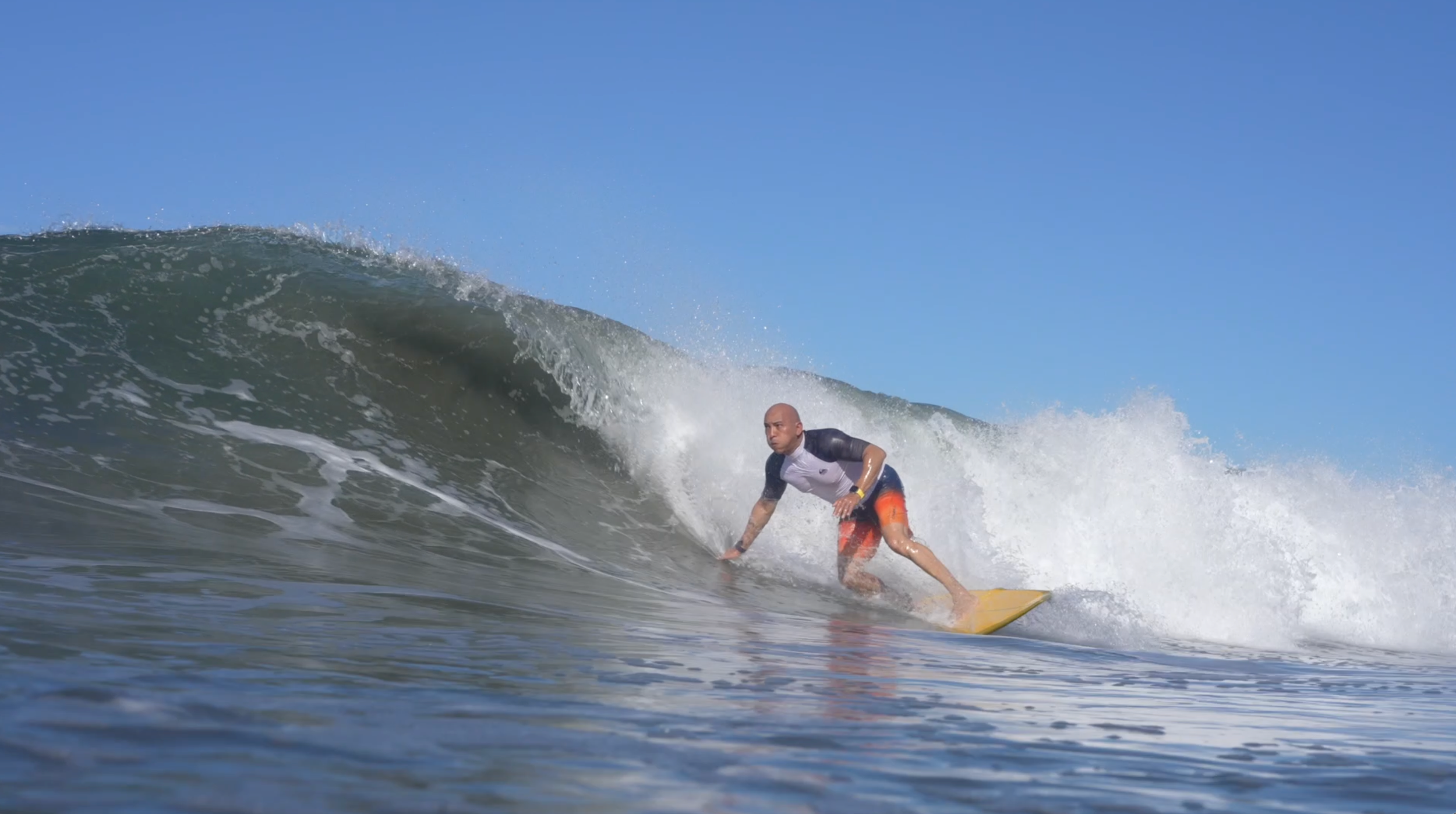
I think I first stood up on a surfboard when I was 20, maybe 21. It was France, on the Atlantic coast. I'm from Germany, so there's not a lot of surf there. So I was on vacation. I just tried it out.

I remember the feeling of “Weeeeee!” — that's what I remember — and that's pretty much what I'm going for today.

I usually go out every morning, rain or shine, onshore or offshore, and just see what I can find.

All I want to do is paddle for a wave, and catch a wave. And there's this moment between going from paddling to planing, and no matter how much I've progressed with surfing, it's that moment that still contains the “weeeeeee” 

What does surfing give me? It's like this game of chasing this little feeling.

I'm looking for that moment, that moment, just that moment.

I actually think about aging only insomuch as I've looked at sort of where I am today and right now, I'm actually the fittest and happiest I've been in my life, right in the last two, three, four years. And so when everything's awesome, I kind of wonder, ‘Okay, this is great. And so in that context, I'm thinking, ‘Well, how long can you possibly reasonably keep that?’ 

And so I think when I just look at other people in general, most healthy, fit people, you will find that after age 60, they tend to be called ‘fit for their age.’ At least that's my observation. 

So I think about aging in terms of like, yeah, probably till I'm 60 I can keep this up, and then I'm gonna have to work harder to not decline too fast. That's how I think about aging, but in a very abstract, intellectual way, not so much in an emotional way.

I'm an engineer by trade, and optimization is what engineers do. You always have constraints, and that's what you work with. And early in my local surf journey here, where I started going more regularly and became part of the dawn patrol crew here, I learned about displacement-hull surfboards. And lots of people here really like them, and they were trying to sell me on the benefits of the hull. 

A hull bottom is basically shaped like the bottom of a boat. So it's like a belly, and most surfboards that come a little bit more from the performance, short-board design world are concave, which means that they have the opposite of the belly, so it's pushed in at the center. And so I wanted to understand what that bottom shape does if you kept everything the same. 

And you can't buy two identical surfboards except where one has a convex and the other one has a concave bottom. So I said, ‘Oh, why don't I figure out how to make that and see if I can feel the difference?’ 

And so I contacted a local guy who makes surfboards and said, ‘Hey, can you help me figure that out?’ And he showed me how he makes boards. And so I took two of these same boards to the water and couldn't feel the difference. 

But by the time we had finished building those two boards, I'd fallen in love with the process of building. And the reason why I love the process is that it brings a lot of really interesting things together. So the first one is to think about design. And maybe you have your own, however scientifically informed ideas of how water and flowing water interacts with a planing surface. 

And then there's the aspect of the craftsmanship, but sort of the sculpting, which is not scientific at all. And then the third piece for me is having a canvas on which you can put color and art.  

And so all these three things come together. And so at the end of making these first two surfboards, I'd fallen in love with that process for those reasons. And so I started to say, ‘I want to make more surfboards!’

And over time, I've completely departed from the idea of optimization, because to me, what I've understood from an engineering perspective is that surfboards are necessarily sub-optimal watercraft. They cannot be optimized in the engineering sense. If you think about, let's say, a speed boat or an oil tanker or something like that, you will optimize for a vessel in a very controlled environment, like a mostly flat surface, right? 

And then you say, ‘I'm optimizing for speed or stability or fuel efficiency or whatever.’ But there’s one parameter that you really want to go for: we're surfing. What you're really optimizing for is having fun! 

And so you have to make it unstable so you can turn it, but you also  want it to actually plane. So all you're doing, really, is you're changing some parameters to find a certain configuration of not-optimal, that brings you the most fun for you. And so that's really why optimization, in the engineering sense, is not part of that thinking, even though that's what sparked the journey. 

I found that the language describing the sensations of surfing is really limited. People will say, ‘Well, this board feels loose.’ That's a great word, but it doesn't carry a lot of meaning if you don't say where in the whole surfing process it feels loose. Does it feel loose because you're dropping into the wave, you're setting your rail at the bottom turn, and then it's loose because it rolls easy on the rail, or because your tail slides out? Is it really loose at the top of the wave when you whip your tail around? Those are different meanings, right? 

And so I'm constantly trying to optimize for this – asking about different ride experiences on the different demo boards I give people. Like, ‘How does it paddle around? Versus, how does it paddle into the wave? Versus, how does it feel to set the rail? How does it feel to bottom turn? How does it feel to top turn? How is the dive? All of these things will tell me more than sort of a free-form feedback of like, how did it go?

One question that I've started asking recently is, “What's more important to you? Quantity or quality?’

I think the fewer waves you catch, the more critical your board experience is going to be. So if you’re focused on quality with fewer waves, the waves become more precious, and maybe you’re less open to experimentation. But playing with equipment more, in my opinion, is better, and everybody should be trying new boards all the time.

***


I don't think there's a big question in my life that is different from the sum of the little questions, like, ‘Are my kids gonna be okay? Are they gonna turn out okay?’ But that's not even a big question. You've heard the saying that days are long but the years are short, and so I don't even think about a big question. Things are just really good right now. There's no existential question.

I haven’t always been good at being in the moment. Quite the opposite. Like, I'm generally somebody with a very, very broad, long view. There was a time in my life where my professional life was not going the way I wanted it to. And so one big question that I was grappling with was, what major changes do I need to make to not make the arc of my career a failure? 

Basically, if I think about the path that I chose – starting a software company – as a bet, and then you do that in the hopes of it paying off, and if, over time, it looks like it might not, you might get nervous. And so you’ve got to see if you can sort of make changes so that bet doesn't go to zero, but you walk away with something. And I think that was the big question.

So at that moment I decided to change how I run my company. Some companies are designed to grow really fast, you know, either soar and fly, or sort of hit the wall, crash and burn and I think if you're on that kind of path, if you don't make it by definition, well, you’ve got to fail to start anew. And I think the path that I was on was neither, and it wasn't clear how I could turn that into a win, even if it's not gonna be a huge, insanely big success. And so that was a big question.

So instead of a big all-or-nothing bet I managed to find a path that, you know, put it somewhere in the middle.

So, yeah, have more fun! And have different fun.